Battery energy storage is becoming an increasingly important part of solar PV systems. But adding a battery is not simply a matter of selecting the required kWh capacity. One of the first architectural decisions is how the battery will be electrically connected to the PV system.
Two common approaches are:
- AC-coupled storage
- DC-coupled storage
Both can provide energy shifting, backup power and better utilization of solar energy. However, they differ significantly in energy-conversion paths, efficiency, retrofit capability, inverter requirements, PV clipping and system complexity.
There is therefore no universal answer to the question, “Which one is better?” The better architecture depends on whether the system is new or being retrofitted, how the PV and battery will be operated, the desired backup functionality, interconnection constraints and project economics.
1. What Is a AC-Coupled System?
The easiest way to understand the difference is to look at where the battery connects to the system.
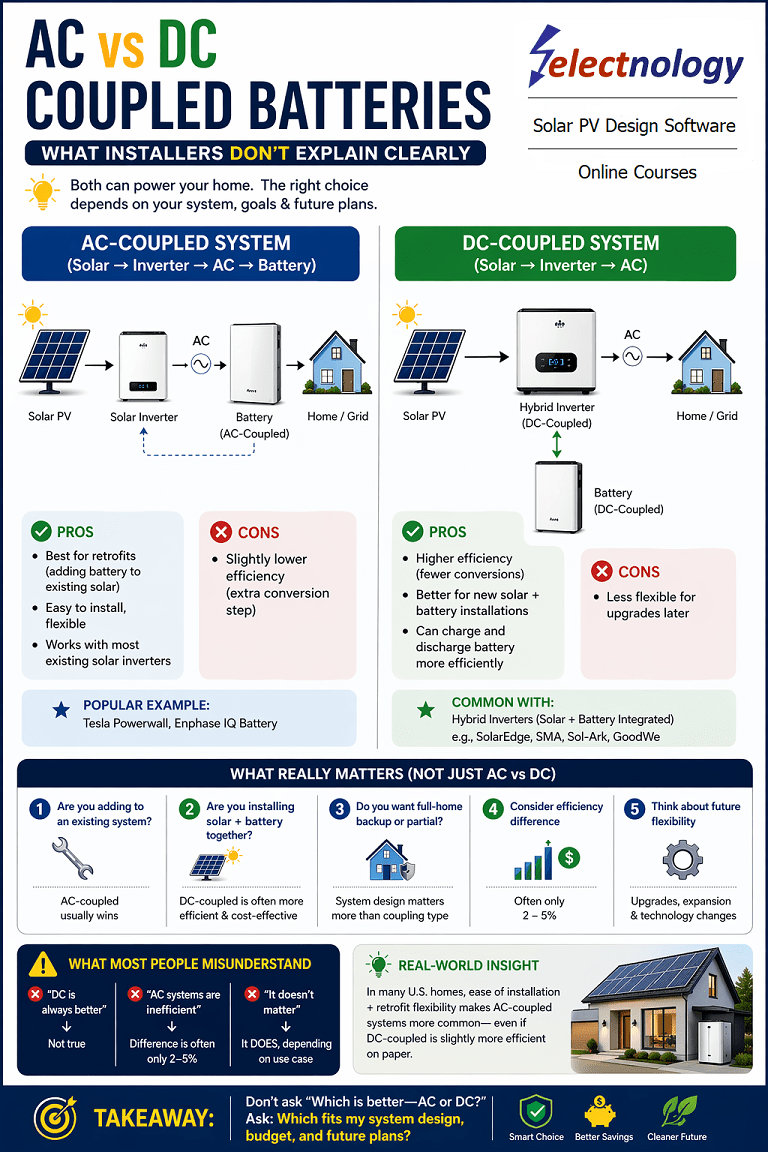
In an AC-coupled system, the PV array and battery each have their own power-conversion equipment and meet on the AC side and connected to the home.
A simplified energy path is:
PV Modules → PV Inverter → AC Bus → Loads / Grid
while the battery follows:
Battery → Bidirectional Battery Inverter → AC Bus → Loads / Grid
When solar energy is used to charge the battery, it must pass through the PV inverter and then through the battery inverter. The U.S. Department of Energy describes AC coupling as a configuration in which PV and storage are connected on the AC side, with the PV system using its own inverter and the battery using a bidirectional inverter.
The important feature is that PV and battery are separate on the DC side and connect together on the AC bus.
2. What Is a DC-Coupled System?
In a DC-coupled system, the PV array and battery are connected on the DC side of the main power-conversion system. The exact architecture varies by equipment manufacturer and project design. Some systems use a shared bidirectional inverter with DC/DC conversion between the PV array and battery, while others integrate these functions differently.
The fundamental concept remains the same:
PV and battery share the DC side of the power-conversion system before electricity reaches the AC grid/load side.
NREL’s utility-scale PV-plus-storage model, for example, uses a DC-coupled configuration in which PV and battery storage share a bidirectional inverter. In a conventional hybrid system or hybrid Inverter, both PV and Battery are connected to the DC side of the Inverter.
3. AC Coupling: Major Advantages
4.1 Excellent for Retrofitting Existing PV Systems
This is probably the biggest practical advantage of AC coupling.
Suppose a homeowner already has:
PV Modules → Existing PV Inverter → House
and later decides to add a battery.
With AC coupling, the battery system can generally be added on the AC side without replacing the existing PV inverter.
This can make AC coupling particularly attractive for the rapidly growing market of adding batteries to existing residential PV systems.
4.2 Independent PV and Battery Systems
Because the PV and battery have separate inverters, they can often be upgraded or replaced independently.
This modularity can be valuable over the long life of a solar-plus-storage system.
4.3 Straightforward Architecture
From an electrical-system perspective, AC coupling can resemble two independent systems connected to the same AC network:
PV system + battery system
This can simplify certain aspects of installation and expansion.
4.4 Grid Charging
Depending on the equipment and applicable utility/interconnection rules, AC-coupled batteries can generally be charged from the grid as well as from PV.
This can be useful for:
- Time-of-use arbitrage
- Demand management
- Backup preparation
- Grid services
4. AC Coupling: Limitations
5.1 More Conversion Steps When Charging From PV
This is the main technical disadvantage.
Solar energy may have to go through:
DC → AC → DC
before reaching the battery.
The additional conversion introduces additional losses.
5.2 More Inverter Equipment
An AC-coupled system normally requires:
- A PV inverter
- A battery bidirectional inverter
whereas a DC-coupled architecture can use a shared inverter in appropriate system designs.
NREL’s utility-scale cost analysis identifies the additional inverter, wiring and inverter-housing requirements as an important difference between AC- and DC-coupled configurations.
5.3 PV Clipping Cannot Normally Be Recovered by the Battery
This is an important distinction.
Suppose:
- PV array = 12 kW DC
- PV inverter = 10 kW AC
At periods of very high solar irradiance, the PV array may be capable of producing more than 10 kW, but the inverter limits the output to approximately its rated capacity.
The excess is known as inverter clipping. In a conventional AC-coupled architecture, the battery is downstream of the PV inverter. Therefore, energy that has already been clipped by the PV inverter cannot normally be recovered by the battery.
This is one of the important advantages of DC coupling.
6. DC Coupling: Major Advantages
6.1 Can Capture Energy That Would Otherwise Be Clipped
This is one of the strongest arguments for DC coupling. With a suitable DC-coupled battery: The battery can absorb some of the DC energy that would otherwise exceed the inverter’s AC capacity.
NREL identifies the ability to capture otherwise clipped PV energy as a major operational benefit of DC coupling.
This can become particularly valuable when a project intentionally uses a high inverter loading ratio (ILR).
However, it is important not to overstate this benefit. NREL’s representative U.S. utility-scale system with an ILR of about 1.3 was estimated to lose only around 0.0%–0.5% of DC generation to clipping across most of the contiguous United States. The benefit becomes more significant as the PV array is increasingly oversized relative to the inverter.
6.2 Fewer Conversion Steps for PV-to-Battery Charging
When PV directly charges the battery on the DC side, the energy can avoid the DC-to-AC-to-DC sequence associated with AC coupling. This can improve the efficiency of the PV-to-storage path, depending on the actual equipment architecture and operating conditions.
6.3 Potentially Better Use of a Limited Grid Interconnection
This is particularly interesting for utility-scale projects. Suppose a project has a limited AC interconnection capacity. A DC-coupled battery can capture additional PV energy on the DC side and discharge it later when the PV output is lower. This can allow the project to make better use of its existing AC infrastructure.
NREL’s analysis highlights the ability of DC-coupled systems to capture energy that would otherwise be clipped and notes that higher PV inverter loading ratios can increase the potential value of this architecture.
7. DC Coupling: Limitations
7.1 More Difficult Retrofit
This is probably the biggest disadvantage for an existing PV installation.
If the existing system has:
PV → Grid-Tied Inverter
adding a DC-coupled battery may require significant changes to the inverter architecture.
NREL notes that replacing the existing PV inverter with a bidirectional inverter and rewiring the system can make DC-coupled retrofits more expensive than AC-coupled alternatives.
7.2 More Integrated Design
The PV, battery, DC/DC conversion and inverter must be designed as a coordinated system.
This can make engineering and commissioning more complicated.
7.3 Additional DC Equipment
Depending on the architecture, the system may require:
- DC/DC converters
- Charge controllers
- Additional DC protection
- Specialized DC wiring
- More sophisticated controls
NREL points out that DC coupling can save on shared inverter costs but may require additional DC/DC conversion and more sophisticated controls.
7.4 Potentially More Complex O&M
The greater integration of PV and battery equipment can make troubleshooting more specialized.
In some utility-scale architectures, distributed battery racks associated with DC coupling can also increase structural, electrical, thermal-management and fire-suppression requirements compared with larger centralized AC-coupled battery systems.
8. What About Backup Power?
Both architectures can provide backup power.
The important point is that backup capability is determined by the overall system architecture and controls—not simply whether the system is AC- or DC-coupled.
During a grid outage, the system needs to:
- Detect the grid outage.
- Isolate the backed-up loads from the utility grid.
- Establish a stable local AC supply.
- Coordinate PV and battery operation.
- Manage battery state of charge and available PV power.
Therefore, when comparing products, it is better to ask:
“How does this particular system operate during an outage?”
rather than simply:
“Is it AC-coupled or DC-coupled?”
Both architectures can be designed to provide backup power. NREL’s residential analysis considered both AC- and DC-coupled systems capable of providing backup to critical loads.
9. Side-by-Side Comparison
| Characteristic | AC-Coupled | DC-Coupled |
|---|---|---|
| PV and battery connection | AC side | DC side |
| PV inverter | Separate | Often shared/integrated |
| Battery inverter | Separate | Integrated/bidirectional |
| PV → Battery conversion path | More conversion steps | Fewer conversion steps |
| PV-to-battery efficiency | Generally lower | Generally higher |
| Existing PV retrofit | Excellent | More difficult |
| PV clipping recovery | Limited | Major advantage |
| Grid charging | Generally straightforward | Depends on architecture |
| System integration | Simpler/modular | More integrated |
| New PV + battery project | Very suitable | Very suitable |
| O&M architecture | More independent | More integrated |
| Utility-scale high-ILR projects | Suitable | Particularly attractive |
| Residential retrofit | Often preferred | Usually less attractive |
| Residential new installation | Very suitable | Very suitable |
The table should not be interpreted as saying that one architecture is universally superior. Actual performance depends on equipment efficiencies, control strategy, sizing, operating profile and project objectives.
10. So Which Architecture Is Better?
The answer depends primarily on the project.
Choose AC Coupling When:
You already have solar and want to add batteries.
This is probably the clearest case for AC coupling.
It can allow the existing PV inverter to remain in service and can reduce the amount of PV-side modification required.
It is also attractive when:
- modularity is important,
- PV and battery systems may be upgraded independently,
- the system is primarily intended for backup,
- PV energy is often consumed directly,
- or a simple retrofit is desired.
Consider DC Coupling When:
You are designing a new PV-plus-storage system.
DC coupling becomes particularly attractive when:
- maximizing PV-to-battery efficiency is important,
- PV clipping is significant,
- the PV array is substantially oversized relative to the inverter,
- the AC interconnection is constrained,
- or the project is designed specifically around integrated PV + storage operation.
NREL uses DC coupling as its representative utility-scale PV-plus-storage architecture in its Annual Technology Baseline, partly because of these operational synergies.
11. An Important Point: Don’t Compare Only “Round-Trip Efficiency”
It is tempting to ask:
“Which battery system has the highest round-trip efficiency?”
That is useful—but it is not enough.
The real question is:
How much useful energy does the entire PV-plus-storage system deliver over its lifetime?
Consider two systems:
System A
Higher battery round-trip efficiency but significant PV clipping.
System B
Slightly lower battery efficiency but a DC-coupled architecture that captures substantial clipped PV energy.
System B could potentially deliver more useful energy overall.
Similarly, an AC-coupled retrofit could be economically superior even if its PV-to-battery conversion path has more losses, because avoiding replacement of an existing PV inverter may save significant installation cost.
Therefore, system-level energy yield and economics are more important than a single efficiency number.
12. The Decision Framework
A practical design decision can follow this sequence:
Step 1 — Is the PV system new or existing?
Existing → AC coupling deserves strong consideration.
New → Both architectures should be evaluated.
Step 2 — Is PV clipping significant?
If yes:
DC coupling becomes more attractive.
If no:
The clipping advantage of DC coupling may be relatively small.
Step 3 — Is the AC interconnection constrained?
If yes:
DC coupling may provide additional value by capturing DC energy that would otherwise be curtailed or clipped.
Step 4 — Is retrofit simplicity important?
If yes:
AC coupling generally has the advantage.
Step 5 — Is maximum PV-to-storage efficiency important?
If yes:
DC coupling generally deserves serious consideration.
Step 6 — What does the economic model say?
Ultimately, the decision should consider:
- Capital cost
- Energy losses
- PV clipping
- Battery degradation
- Replacement costs
- Backup requirements
- Interconnection limitations
- O&M
- Electricity tariff structure
- Incentives
- Expected system lifetime
13. Conclusion
AC- and DC-coupled battery systems are not competing technologies in which one must inevitably replace the other.
They are different system architectures optimized for different situations.
AC coupling is particularly attractive for existing PV systems and retrofit applications. Its modular architecture allows the PV and battery systems to remain relatively independent and can avoid replacing an existing PV inverter.
DC coupling is particularly attractive for new PV-plus-storage systems where maximizing PV-to-battery efficiency, recovering clipped PV energy, or working within a constrained AC interconnection is important.
So the better question is not:
“AC or DC—which is better?”
It is:
“Which architecture delivers the best combination of energy yield, cost, flexibility and reliability for this particular PV-plus-storage application?”
That is the engineering question that should drive the design.
References
- National Renewable Energy Laboratory (NREL) — Utility-Scale PV-Plus-Battery, Annual Technology Baseline. Discussion of DC- and AC-coupled architectures, efficiency, clipping, inverter loading ratio and system costs.
- NREL — U.S. Solar Photovoltaic System and Energy Storage Cost Benchmarks: Q1 2020. Includes a detailed comparison of AC- and DC-coupled systems and the advantages of AC coupling for battery retrofits.
- U.S. Department of Energy — Solar-Plus-Storage 101. Overview of AC- and DC-coupled PV-plus-storage architectures.
- NREL / U.S. Department of Energy — Best Practices for Operation and Maintenance of Photovoltaic and Energy Storage Systems. Discussion of AC- and DC-coupled configurations and their energy-conversion paths.
- NREL — Evaluating Utility-Scale PV-Battery Hybrid Systems. Comparison of AC- and DC-coupled configurations and retrofit considerations.
- Enphase Energy — AC-Coupled vs. DC-Coupled Batteries: Which Is Better? Practical residential perspective on the two architectures and battery retrofits.