Adding a battery to a residential solar PV system is not simply a matter of deciding how many kilowatt-hours of battery storage are needed. Moreover, it also depends upon the level of configuration available in the Inverter to which Battery shall be connected. How much energy units shall be stored or consumed out of battery all depends upon the configuration made in the associated Inverter and load demand. However, we shall focus only on size of the battery in this article.
A common mistake is to think:
“I have a 10 kW solar system, so I need a 10 kWh battery.”
There is no general rule that says a battery should have the same numerical kWh capacity as the PV system’s kW rating.
A properly sized battery depends much more on how the home uses electricity, when solar energy is available, how much backup power is required, and how much of the battery’s capacity can actually be used.
This article explains the major factors that should be considered when sizing a residential battery for a solar PV system.
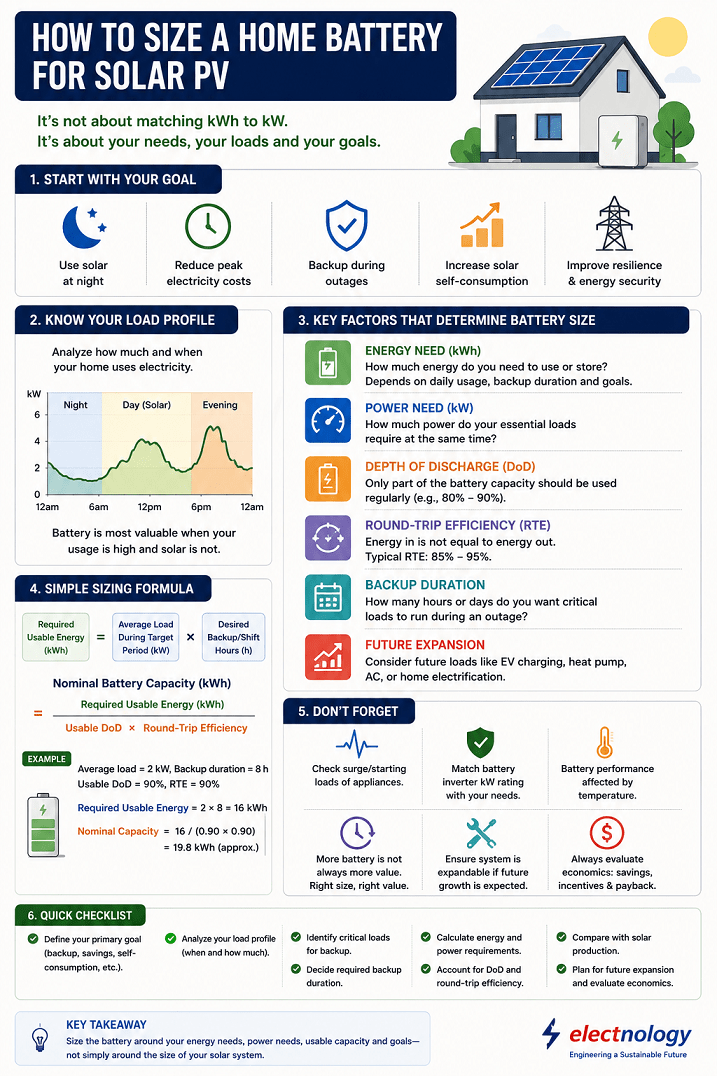
1. Start With the Purpose of the Battery
Before calculating battery capacity, determine what the battery is supposed to accomplish.
A residential battery may be installed for several different reasons:
- Use solar energy at night
- Reduce electricity purchased during expensive peak periods
- Provide backup during grid outages
- Increase solar self-consumption
- Reduce demand charges where applicable
- Provide resilience for critical household loads
- Take advantage of time-of-use electricity tariffs
These objectives can lead to very different battery sizes.
For example, a homeowner interested mainly in evening energy shifting may need a relatively modest battery.
A homeowner who wants to operate essential loads through a long outage may require considerably more storage.
The U.S. Department of Energy notes that solar-plus-storage can shift solar energy to periods when electricity demand is higher and can also provide backup power during grid interruptions.
2. Battery Energy Capacity vs Power Capacity
One of the most important concepts in battery sizing is the difference between energy capacity and power capacity.
Energy Capacity — kWh
This tells us how much energy units the battery can store.
For example:
10 kWh battery
means the battery has approximately 10 Units of rated energy capacity under specified conditions.
Power Capacity — kW
This tells us how much power the battery/inverter can deliver at a given instant.
For example:
10 kWh battery + 5 kW inverter
can potentially provide 5 kW of power, but the battery’s available energy determines how long that power can be sustained.
The U.S. Department of Energy makes the same fundamental distinction: storage systems have an energy capacity and a power capacity, and different combinations of the two are appropriate for different applications.
This means a battery cannot be properly specified by saying only:
“I need a 10 kWh battery.”
We also need to ask:
“How many kW do I need it to deliver?”
3. The First Real Input: Household Load Profile
The most important starting point is the home’s electricity consumption.
Ideally, obtain:
- 15-minute interval data
- 30-minute interval data
- or hourly consumption data
for at least several months, preferably a full year.
Why?
Because two houses may consume the same amount of electricity annually but have completely different load profiles.
Example
House A:
- Annual consumption: 12,000 kWh
- Most electricity used during the evening
House B:
- Annual consumption: 12,000 kWh
- Most electricity used during daylight hours
House A has greater potential value from battery storage because more solar energy may need to be shifted from daytime to evening.
DOE notes that solar production and electricity demand do not necessarily coincide; storage allows energy generated during sunny periods to be used later when demand increases.
4. Don’t Size the Battery From Daily Energy Consumption Alone
Suppose a home consumes:
30 kWh/day
It would be tempting to specify:
30 kWh battery
But that may be completely unnecessary.
Perhaps:
- 15 kWh is consumed during daylight
- 10 kWh during the evening
- 5 kWh overnight
If the objective is only to shift excess solar into the evening, perhaps a battery around 10–15 kWh could be more appropriate.
Conversely, if the objective is to provide backup for essential loads for an extended outage, the required capacity could be much larger.
The correct question is therefore:
How much energy needs to be shifted or supplied by the battery during the intended operating period?
5. Identify the Critical Loads for Backup
Backup sizing is different from energy-arbitrage sizing.
A homeowner may not need the entire house operating during an outage.
Instead, the backup system may supply a critical-load panel containing:
- Refrigerator
- Freezer
- Lighting
- Internet equipment
- Security system
- Selected outlets
- Medical equipment
- Gas furnace controls
- Well pump
Large loads such as:
- electric water heaters
- electric heating
- central air conditioning
- EV chargers
- electric ranges
may either be excluded or managed separately.
This can dramatically reduce the required battery size.
Example
Suppose the critical loads average:
2 kW
and the desired backup duration is:
8 hours
The basic energy requirement is:
2 kW × 8 h = 16 kWh
But this is not yet the required battery nameplate capacity because battery losses and usable-depth limitations must be considered.
NREL similarly emphasizes that backup duration depends on the battery’s state of charge, the time of the outage and the home’s load profile.
6. Depth of Discharge (DoD)
A battery’s rated capacity is not necessarily the same as the energy that should routinely be extracted from it.
Depth of Discharge (DoD) describes how much of the battery’s usable capacity is discharged.
For example, if a battery has:
20 kWh rated capacity
and the specified usable DoD is:
90%
then the approximate usable energy is:
20 × 0.90 = 18 kWh
Battery manufacturers may specify usable capacity directly, in which case the designer should use the manufacturer’s specified usable value rather than applying another DoD factor.
DoD is important because operating a battery within its specified limits can influence its usable life and performance.
7. Round-Trip Efficiency
A battery does not return all the energy that was used to charge it.
There are losses in:
- Battery charging
- Battery discharge
- Inverters
- DC/DC converters
- Wiring
- Controls and auxiliary equipment
This is represented by round-trip efficiency (RTE).
For example, assume:
Round-trip efficiency = 90%
If 10 kWh of energy is sent into the storage system, approximately:
10 × 0.90 = 9 kWh
may be available on the other side of the complete storage cycle, depending on how the manufacturer defines the efficiency boundary.
NREL’s modeling of PV-plus-storage explicitly accounts for battery, power-electronics and parasitic losses when evaluating system performance.
Simple Example
Suppose the home needs:
16 kWh
of usable energy from the battery.
Assume:
- Usable DoD = 90%
- Round-trip efficiency = 90%
A simplified calculation might be:
Required nominal capacity ≈ 16 / (0.90 × 0.90)
≈ 19.8 kWh
This is an illustrative calculation. Actual sizing should use the manufacturer’s definitions of rated and usable capacity and the applicable charging/discharging efficiency.
8. Battery Power Rating Is Just as Important
A 20 kWh battery does not necessarily mean it can supply a 20 kW load.
Suppose:
Battery = 20 kWh
Inverter = 5 kW
The system may be capable of supplying approximately 5 kW maximum AC power, subject to the equipment ratings.
If the home suddenly requires:
8 kW
the battery system may not be able to supply the entire load even though it has plenty of stored energy.
Therefore battery design has two dimensions:
Energy → kWh
Power → kW
This is particularly important for backup systems.
9. Peak Demand and Starting Loads
Some household equipment has a significant starting or transient power requirement.
Examples include:
- Air-conditioning compressors
- Well pumps
- Refrigerators
- Freezers
- Motors
A system might therefore have:
Average load = 2 kW
but:
Momentary demand = 6 kW
If the battery inverter cannot handle the required surge, the system may trip even though the battery has sufficient stored energy.
Therefore, backup design should consider both:
- continuous power
- transient/starting power
This is one reason a battery should not be selected purely on its kWh rating.
10. How Much Backup Time Do You Actually Need?
Another important question is:
How long should the battery operate without the grid?
Possible objectives include:
Short Backup
2–4 hours
Suitable for:
- brief outages
- evening load shifting
- essential household loads
Overnight Backup
8–12 hours
Useful where the objective is to cover the evening and night until solar production resumes.
Extended Backup
24 hours or more
This requires considerably more storage and may require load management.
NREL’s residential storage guidance notes that grid-connected residential storage is often considered for roughly one to two days of autonomy, while also emphasizing that longer outages can make other backup technologies economically attractive.
However, there is no universal “correct” backup duration. It depends on the local outage profile, homeowner priorities and economics.
11. Don’t Ignore the Solar Array
The PV system still matters—but it should not be the starting point.
Consider a house with:
10 kW PV
and:
30 kWh/day consumption
The important questions are:
- How much energy does the PV generate?
- How much is consumed directly?
- How much is exported?
- How much excess solar is available for charging?
- When does the excess occur?
- How much energy is required after sunset?
A battery that is much larger than the available excess solar may frequently remain underutilized.
This leads to an important principle:
A battery should be sized in relation to both the load profile and the available solar energy—not simply the PV array’s nameplate capacity.
12. A Simple Residential Example
Consider a hypothetical home:
PV system: 8 kW
Daily household consumption: 24 kWh
Suppose:
- 10 kWh is consumed directly during daylight
- 8 kWh is consumed in the evening
- 6 kWh is consumed overnight
Assume the PV system regularly produces enough surplus energy to charge the battery.
If the objective is primarily to shift solar energy into the evening, the battery might be designed around the evening energy requirement rather than the entire 24 kWh daily consumption.
Suppose we target:
10 kWh usable battery energy
and assume:
- Usable DoD = 90%
- Round-trip efficiency = 90%
A simplified nominal requirement becomes:
10 / (0.90 × 0.90) ≈ 12.3 kWh
A commercially available battery around this size could therefore be evaluated.
But we still have to check:
- Battery maximum charge power
- Battery maximum discharge power
- Inverter rating
- Backup load
- Manufacturer operating limits
- Temperature
- Future load growth
This demonstrates why battery sizing is an engineering exercise rather than a simple PV-to-battery ratio.
13. Future Expansion Should Be Considered
A battery system may have a design life of many years.
During that period, household electricity consumption can change.
Possible additions include:
- Electric vehicle
- Heat pump
- Air conditioning
- Electric water heater
- Home office
- Electrification of cooking
- Additional appliances
A homeowner currently consuming 20 kWh/day may consume 30 kWh/day after electrification.
Therefore, it can be worthwhile to ask:
Can the battery system be expanded later?
Expansion capability may involve:
- Additional battery modules
- Larger inverter
- Additional inverter units
- Larger critical-load panel
- Communication and control capacity
The designer should check the manufacturer’s limits rather than assuming batteries can always be added later.
14. A Practical Battery Sizing Workflow
A useful residential design process can be summarized as follows:
Step 1 — Determine the objective
Is the battery primarily for:
Self-consumption?
Time-of-use shifting?
Backup?
Demand reduction?
Or a combination?
Step 2 — Obtain the load profile
Preferably use interval data rather than annual kWh alone.
Step 3 — Identify critical loads
Determine what must remain powered during an outage.
Step 4 — Determine required backup duration
For example:
4 hours, 8 hours, 12 hours, 24 hours, etc.
Step 5 — Calculate required energy
Approximate:
Required energy = Average backup load × Required backup hours
Step 6 — Account for usable capacity and losses
Consider:
- Usable DoD
- Round-trip efficiency
- Temperature
- Manufacturer operating limits
Step 7 — Check power requirements
Verify:
- Continuous kW
- Peak kW
- Motor starting requirements
Step 8 — Compare with PV production
Make sure sufficient excess solar energy is available to recharge the battery under the intended operating conditions.
Step 9 — Consider future loads
Ask whether EVs, heat pumps or other electrification will increase demand.
Step 10 — Evaluate economics
Finally compare:
- Battery cost
- Expected energy savings
- Backup value
- Tariff structure
- Battery degradation
- Expected lifetime
- Replacement/expansion requirements
15. A Useful Concept: Hours of Autonomy
One simple way to think about battery sizing is:
Hours of Autonomy = Usable Battery Energy ÷ Load
For example:
10 kWh usable battery
with:
2 kW average load
provides approximately:
5 hours of autonomy
NREL uses this concept as a useful metric for behind-the-meter storage systems.
However, remember that household load is not constant.
A home may consume:
- 1 kW at one moment
- 3 kW later
- 0.5 kW overnight
- 5–8 kW when large appliances start
Therefore, an hourly load profile is much more informative than simply dividing annual energy consumption by 8,760 hours.
16. Common Battery-Sizing Mistakes
Mistake 1 — Matching Battery kWh to PV kW
An 8 kW PV system does not automatically require an 8 kWh battery.
Mistake 2 — Using Annual Consumption Alone
Annual kWh tells you how much energy is used, but not when it is used.
Mistake 3 — Ignoring Peak Power
A battery may have sufficient energy but insufficient power.
Mistake 4 — Ignoring Backup Loads
The battery requirement can change dramatically depending on whether air conditioning, heating, EV charging and other large loads are backed up.
Mistake 5 — Ignoring Efficiency
The energy entering a battery is not the same as the energy ultimately delivered to the home.
Mistake 6 — Ignoring Future Electrification
Today’s load may not be tomorrow’s load.
Mistake 7 — Oversizing Without an Economic Reason
More battery capacity does not necessarily mean proportionally more value.
NREL notes that storage generally has decreasing marginal utility as system size increases.
17. So, How Big Should a Home Battery Be?
There is no universal answer.
A useful first approximation is:
Battery size ≈ Energy that needs to be shifted or backed up ÷ usable fraction ÷ efficiency allowance
But the final design should also satisfy the required:
Power capacity (kW)
and should be checked against:
- PV production
- Load profile
- Backup objectives
- Battery operating limits
- Inverter capability
- Future loads
- Economics
Conclusion
The best residential battery is not necessarily the largest battery—or the one with the same numerical rating as the PV system.
A properly designed battery should answer four fundamental questions:
1. How much energy do I need?
2. How much power do I need at any instant?
3. How long do I want the battery to operate?
4. How much of that energy can the system actually deliver?
Once these questions are answered, the PV system, load profile, battery chemistry, usable capacity, inverter power, efficiency and future expansion can be evaluated together.
The most important principle is:
Size the battery around the application’s energy and power requirements—not simply around the size of the solar array.
A well-sized battery can improve solar self-consumption, provide valuable backup capability and make better use of renewable energy. An oversized battery, however, may add cost without delivering proportional additional value.
For residential PV+BESS design, load profile + operating objective + power requirement + usable energy should therefore be the starting point—not simply the PV system’s kW rating.
References
- U.S. Department of Energy — Solar Integration: Solar Energy and Storage Basics. Explains the relationship between solar generation, electricity demand, storage energy capacity and power capacity.
- National Renewable Energy Laboratory — Technology Tips for Solar + Storage: Sizing a System. Discusses battery power, energy capacity, hours of autonomy, battery lifetime and diminishing marginal utility of increasing storage size.
- NREL — U.S. Solar Photovoltaic System and Energy Storage Cost Benchmarks. Provides residential PV-plus-storage analysis and highlights the importance of load profile, battery state of charge, depth of discharge and inverter efficiency for backup duration.
- U.S. Department of Energy — Solar and Resilience Basics. Explains how PV-plus-storage can provide backup power during grid outages and the role of properly configured inverters and storage.
- U.S. Department of Energy FEMP — Battery Energy Storage System Evaluation Method. Discusses evaluating deployed BESS performance using actual metered charge/discharge data and long-term time-series analysis.